
Middle East Banks 5-year Strategy is among the key upstream documents of the Bank. The Board of Directors, through this document, designs and envisages MEBs destination, and illuminates the way to guide the organizational values ,in the journey to reach such destination.
Vision
We"ll continue to be the most trusted bank of Iran.
Mission
Value creation for all stakeholders, including shareholders, customers and society, so as to be integrated into the corporate, environmental and social governance through empowering skillful, knowledgeable and responsible staff by applying cutting-edge technologies ,in a transparent, accountable and law-abiding ecosystem.
Values
In the Middle East Bank, we have defined seven core values: meritocracy, accountability and transparency, pragmatism, trustworthiness, reliability, innovation and social and environmental responsibility, to achieve our objectives and vision and to accomplish our missions.
Meritocracy
- Ensuring employment of the ,best human capital at the expected levels, ;with respect to the needs of each level, training such assets and preparing them to accept future responsibilities ,in their designed career path.
- Regular monitoring of the human capital merits, taking into account the ,best practices and an uncompromising attitude vis-à-vis mediocrity at any level.
Accountability and Transparency
- Applying the principle of transparency ,in all of the Banks processes and procedures and providing any information requested by the regulatory and supervisory bodies within the framework of regulations governing the banks activities.
- Holding all the staff, at any level, accountable to internal and external supervisory bodies, in accordance ;with the regulations governing the banks operations.
Pragmatism
- Prioritizing result-oriented-ness by providing clear definitions of the objectives and constantly monitoring them.
- Innovation ,in offering practical solutions ;with the purpose of meeting the needs of stakeholders, within the compliance framework.
Trustworthiness
- Prioritizing the responsibilities of the Bank vis-à-vis shareholders, customers, society and the environment and considering the stakeholders ,best ,interests ,in decisions and operations.
- Continuous performance improvement of the staff to master the business environment and maintain professional conduct and skills, ensuring that the ,best method of action ,in promoting professional trustworthiness ,in interaction ;with stakeholders is recognized.
- Continuous process improvement ;with a view to guaranteeing the reflection of updated commercial and legal obligations therein for the purpose of designing and preserving a structure wherein the proper performance of the Bank and its staff would be possible, guaranteed and subject to monitoring within the framework of compliance ;with rules and regulations and based on the stakeholders ,best interests under any circumstances.
- Continuous inspection of proper conduct of all colleagues ,in all levels as well as the designed processes, ;with zero tolerance towards any misconduct.
- Compliance awareness, adherence to laws and regulations, prioritizing commitment to and abiding by them ,in all conditions without compromise.
- Full and transparent cooperation ;with supervisory/regulatory bodies.
Reliability
- Close and continuous relationship ;with the customers for better understanding of their businesses and supporting them ,in various conditions.
- Assuming responsibility and fostering correct judgement and decision-making capacity to empower stakeholders.
- Forming services based on the customers’ needs and foresight of future needs.
Innovation
- Continuous process improvement and organizational innovation.
- Mastering technological developments and taking on commitment to use such developments to streamline processes and offer new services to customers.
- Envisaging stakeholders needs ;with respect to technological changes.
Sustainability and Social and Environmental Responsibility
- Aligning decisions ;with the sustainable development goals of the country.
- Awareness of the consequences of decisions and setting accurate goals ;with due attention to their social and environmental externalities.
- Encouraging stakeholders to effectively contribute to sustainable development goals ;with a local approach.
- Transparency ,in structures, decisions, performance and monitoring of performance.
Strategic Concentration Fields
The following fields form MEB’s strategic focus areas under the current strategic agenda:
- Organic growth through increasing operational profitability, optimizing cost structure and expanding banking operations by designing new products, expanding service channels and acquiring new financial resources within the defined framework, in order to ensure compliance ;with rules and regulations and abiding by effective risk management practices.
- Improving existing products and stabilizing the Banks standing ,in the competitive market of such products, particularly ,in the areas of corporate banking, multinational customers and international affairs.
- Redesign of the organizational architecture to enhance corporate governance, documentation, transparency of processes and institutionalisation, which are to lead into scalability, enhanced productivity, competitiveness, and implementing ,best practices ;with the aim of catching up ;with international advancements and facilitation of joining the global market.
- Monitoring and employing new technologies, in line ;with the Bank’s mission and vision, going through digital transformation and making sure that integrated data and information management is in place, in order to get prepared to use artificial intelligence capacities, integrated risk management, quantification of situations and assisting accountable, clear and inclusive decision making.
- Establishing social and environmental governance, to uphold social and environmental responsibilities in operational, credit and market-related decision making, as well as managing and monitoring the effectiveness and performance of the Bank in those areas.
- Selection, recruitment and retention of human capital, ;with a succession planning approach and due regard to non-reliance on individuals, and enhancing personal and professional development of the staff in order to develop qualified successors to assume strategic responsibilities.
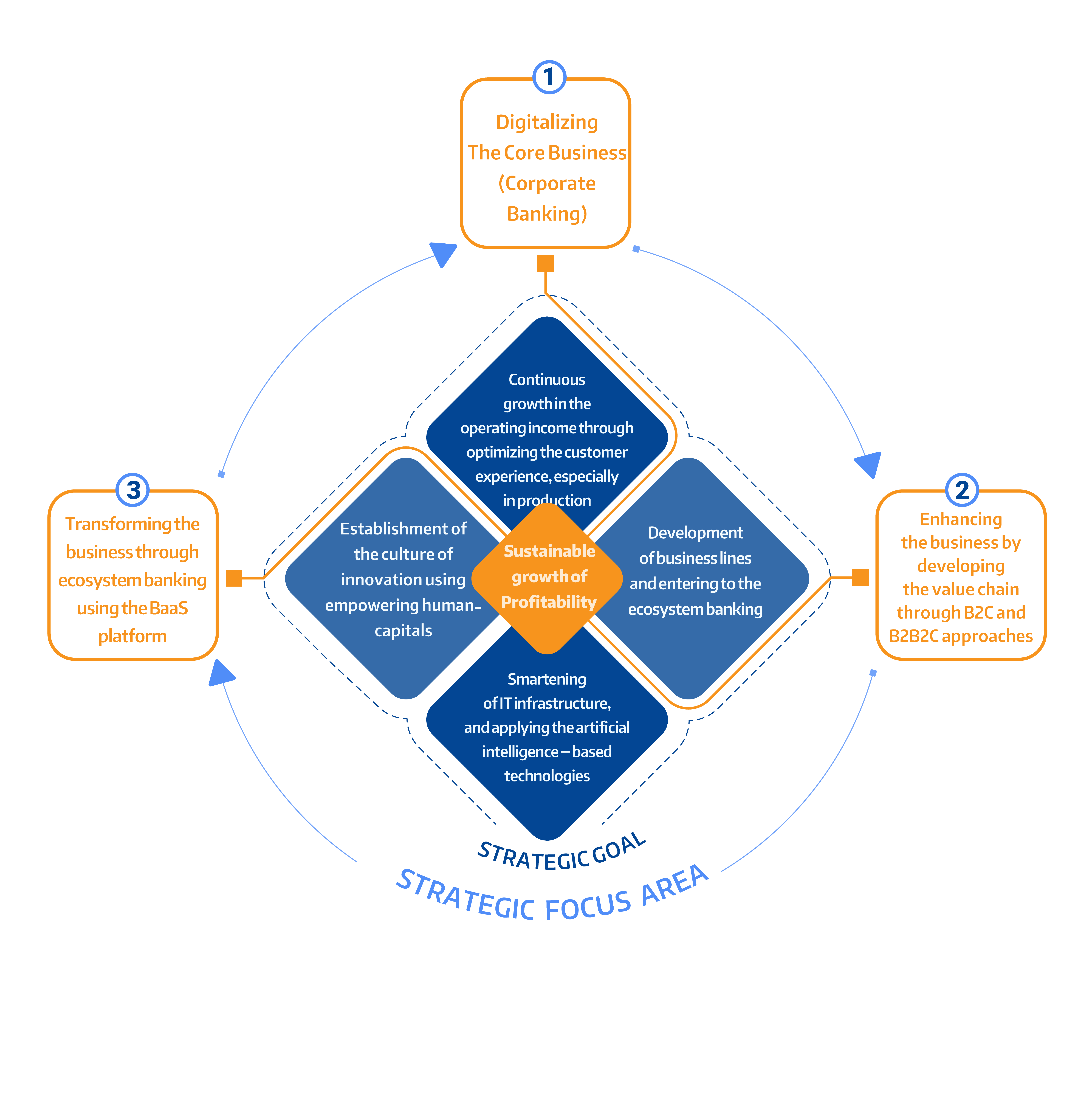
Strategic Principles
The fundamental elements of the Middle East Bank’s strategic framework are illustrated in the following diagram: